26 February 2007


The Amphibian Man (Человек Анфибия ), Russia, 1961

Forget Batman, Superman and all the other super heroes you have known for many years... the Amphibian Man is the real thing! Well, not exactly. At least it was in the former Soviet Union, back in the sixties. This movie, based on a novel by famous Russian writer Alexander Belyaev, tells the story of a young man who can breathe underwater, and so he gets to be called the amphibian man. The movie holds the record in the box office of Soviet movie theaters.

It is your average low budget science fiction movie, only even more low budget thanks to the Soviet special effects crew, whatever that was. Our hero meets Guitare (that would a woman's name) and falls in love. You see, he feels lonely. He lives in a mansion on the top a hill only with his father, a famous scientist, who by the way was the person who operated him as a kid, removing one of his lungs and replacing it with fish gills. It all happens in a strange country (perhaps Cuba, telling from the signs in the streets). More than science fiction it is a romantic story for children. There is dancing and singing, and our hero the Amphibian man does anything he can to keep Guitare by his side. Of course Guitare is about to get married to a rich guy, Don Pedro (yes, that is also the name of a cheap Mexican brandy).

As usual in most Soviet movies, there is a hint of hidden but easy to perceive propagandistic ideology; the Amphibian man goes to town until to come across the "greedy" fish merchant who won't give fish to the poor, while his father the scientist is trying to create an underwater world where there'd be no rich nor poor and everyone would be equal. Does it sound familiar? It is funny because it is too obvious, but I was overall surprised by the DVD transfer; the colors are rich and clear. If you want to discover what science fiction looked like back in the communist Russia, this is a definitely a classic not be missed.
79th Academy Awards

This year I am happy that the German film "The Life of Others" won the Oscar for best foreign language film. However, it's a shame that "Babel" did not win more Oscars.

21 February 2007


The Life of Others (Das Leben der Anderen) Germany, 2006

Poet and playwright Georg Dreyman and his girlfriend, the actress Christa Maria Sieland, lead a successful life in former East German. Sooner than later, the Stasi (State Security) officials begin suspecting Dreyman; he is way too perfect, and he must be hiding something. Hiding what exactly? We never know, but back in those days, almost anything that was not approved by the Communist government was considered suspicious and even illegal. The government places hidden microphones all over Georg's appartment, and he is monitored night and day until they find out he has plans to publish an article in a West German magazine. Nevertheless, the official who finds out about his is too touched by what he is discovering, and perhaps out of pity starts to protect him by reporting lies and hiding Georg's real plans. The movie is extremely well cast. All actors deserve an award here, and the story structure is remarkable, as well as the music score. The is a very intelligent movie that portrays the atrocities committed during the Communist regimes in many Eastern European countries. Little is known abut this period of history, but this movie will surely help bring some attention to this topic.

04 February 2007

Das Doppelleben von Veronika (La Double Vie de Véronique), Frankreich (1991)

Warum ist Krysztof Kieswlowski eigentlich so berühmt? Ich stimme ihnen nicht zu, wenn die Kritiker behaupten, dieser Film sei ein Meisterstück. Meiner Meinung nach ist das nicht der Fall. Hier geht es um eine Frau, die gleichzeitig in zwei Städten wohnt: Die eine in Paris und die andere in Warschau. Die Pariserin, Véronique, ist von Beruf Fotografin. Als sie nach Polen reist, fotografiert sie auf einem Platz zufällig die andere Frau, Weronika. Zurück zu Hause merkt Véronique ihre Doppelgängerin auf dem Foto. Dann später bekommt sie einen Brief, auf dem steht, sie sollte einen unbekannten Mann treffen. Nach dem Treffen erfährt Véronique, dass dieser Mann sie seit langem verfolgt hat. Was will er eigentlich von ihr? Dem Zuschauer wird fast nichts preisgegeben: Es sind nur Vermutungen und abstrakte Dialoge, die für eine eher langweilige Geschichte verantwortlich sind.

Ich hatte früher Besseres von Kieslowski gesehen, wie zum Beispiel der Dekalog oder die Trilogie Bleu, Blanc und Rouge. Das einzige, das ich interessant fand, war die Musik, und wie sie angewendet ist, um Spannung in mancher Szenen zu schaffen.

Hawaii, Oslo (Norway, 2004)

The stories of five different characters come together in a car accident. In one story, a young woman is looking for his boyfriend to get married because she had made a promise 10 years ago. In another story, two kids live by themselves and do graffitti paintings in the walls of downtown Oslo. Their mother tried to commit suicide but finally decides to look for her children. Another story involves a newborn child with a heart deficiency, whose expensive operation is the only option his parents have to save his life. The father decides to go and rob a bank, and by the last scenes all the stories start to come together. The background music is eerie and mysterious, and the photography of downtown Oslo is really good. Why Hawaii? That is the name of a bar in the city, and the place where one of the characters wants to take his brother, who is kept in a mental institution. This film was proposed for an Oscar nomination for best foreign language film in 2004.
The Sweet Hereafter (Canada, 1997)

Director Atom Egoyan explores the feelings and strong emotions of a small community struck by a tragic car accident. A school bus suddenly slips down the road and ends up in a frozen lake. Needless to say, all passengers die and the bus driver is to blame. A lawyer, who at the same time is dealing with his drug-addict daughter, decides to take the case in his hands and interview some of the kids' parents. It is an intense flashback of memories throughout the film, and it's depressing atmosphere will leave viewers wth a bitter, and not sweet, aftertaste. A very emotional and sad made for TV movie from one of Canada's most acclaimed film directors.

28 January 2007

A small church and big stop sign somewhere in Québec

20 January 2007

Woody Allen: three comedies
Hollywood Ending (2002), Anything Else (2003), Zelig (1984)


I got to see three Woody Allen comedies, and although he is not one of my favourite filmmakers, his movies are always original and sometimes sarcastically funny. What I find amazing is Woody Allen's capacity to come up with so many stories in such short periods of time.

In Hollwood Ending, Woody is about to start in an interesting project. He plays the role of a movie director. His former wife proposes a movie project, and he is chosen as the director. Right before shooting begins, he becomes completely blind! According to the doctors it is all merely psychological; there is nothing wrong with his eyes. With the help of his assistant, Woody goes through the whole shooting without ever seeing what he is directing. Nobody suspects until the end, where the plot gets more complicated and poor Woody sees his movie slowly turn into a fiasco.

Anything Else tells the story of a couple, whose unstable relationship affects others in many ways. In this movie, Jerry is a stand-up comedy writer, whose girlfriend (Christina Ricci) always makes his life impossible. She is a wannabe actress who takes too many pills and is only concerned with her weight. Jerry's friend, David (played by Woody Allen) is a neurotic university professor who gives good and bad advices to his friends. Together they make Jerry's life nearly impossible, until David suggests an escape that can save Jerry's career as a writer.

Zelig is a strange film. Shot in black and white, is sort of a fake documentary about the life of a man known as the Chameleon Man, Mr. Zelig (played by Woody Allen) in the 20's and 30's. The Chameleon man was able to change his physical appearance depending with whom he was hanging around. As preposterous as the plot sounds, the excellent cinematography and effort put into creating every character and fake interview make it look like the real thing. Particularily funny are the scenes where the Chameleon Man appears at an outdoor Nazi congregation in Munich, and we see the scene of Hitler giving his speech and in the background the Chameleon Man is waving, or when he interrupts in the middle of a Sunday Mass given by the Pope, appearing in the balcony of the Vatican! A truly original and well done film.

15 January 2007


Sophie Scholl (Deutschland, 2006)

Sophie und ihr Bruder haben in der Zeit des Nationalsozialismus Propaganda gegen das Regime verbreitet. Sie waren selbstverständlich gegen Hitler und seine gesamte Kriegspolitik. Gemeinsam mit anderen Freunden haben die Geschwister Propaganda-Blätter geheim gedruckt. Dann haben sie diese Blätter in Schulen und Universitäten verbreitet. Eines Tages sind Sophie und ihr Bruder von einem Professor erwischt. Sie sind schnell verhaftet und verhört worden. Der gesamte Film handelt von Sophies Verhör.

Am Anfang habe ich gedacht, der Film würde langweilig. Aber im Laufe des Films war ich von dem Dialog zwischen Sophie und der Polizei sehr beeindrukt. Der Verlauf des Verhörs ist sehr interessant. Schliesslich wurden Sophie, ihr Bruder und andere Freunde, die auch an der Vorbereitung der Propaganda-Blätter teilnahmen, vom Gericht zur Todesstrafe verurteilt. Die letzten und traurigen Szenen erinnern den Zuschauer an den Mut und die Stärke dieser jungen Menschen.

06 January 2007


Volver (Spanien, 2006)

Der neueste Film von Almodovar handelt von drei Schwestern. Eine der Schwester (Penelope Cruz) hat eine Tochter. Sie werden plötzlich mit dem Tod ihres Mannes konfrontiert. Es geht eigentlich um einen Mörder. Mutter und Tochter verstecken die Leiche des Mannes. Inzwischen taucht die Mutter von Penelope auf. Sie war vor vielen Jahren gestorben! Ist das die wahre Mutter oder ein Gespenst? Warum ist sie zurückgekommen? Diese Mischung von Realität und vielleicht Fiktion gefâllt mir am besten. Almodovar versucht auch ein bisschen von Spanien zu seigen, indem Penelope, mit Hilfe zwei Musikantern, ein typisches spanisches Lied singt. Hier gibt es keine komische Charakter, oder geistlich zerstörte Männer. Der Film ist insgesamt unterhaltsam und zum Teil lustig. Die Geschichte ist selbstverstândlich mit Almovars Stil stark geprägt.

Babel (2006)

The last film in Inarritu's trilogy deals about human solitude and desperation. Three different stories happenning in three countries are told alternately. In the first one, two Maroccan brothers shoot at a tourist bus hurting one of the passengers. In the second story, a Japanese girl tries to overcome her solitude and the death of her mother in a very unconventional way, and in the last story we see the tragic destiny of a Mexican babysitter after having problems with the border patrol police. We do not get happy endings, the movie might feel a little pessimistic and sad, but there is anyways a slight chance for hope and a better future. As Inarritu stated, he tried to show how human beings, even with modern communication technology, are still having problems understanding each other and accepting their differences. This is one of the best films I saw in 2006.

17 December 2006


Saraband (Schweden, 2005)

Dies ist der neueste Film vom schwedischen Regisseur Bergman. Hier geht es um eine Frau, Marianne, die sich plötzlich entscheidet, ihr Ex-Mann zu besuchen. Er wohnt allein auf dem Land, und ist seit langem in den Ruhestand gegangen. Die Geshichte ist einfach; Hier gibt es keine parallele Geschichten. Später lernen wir Karin kennen. Sie ist das Enkelkind des Ex-Manns. Sie will Musikerin werden, und dafür übt sich viel den Bass. Ihr Professor ist ihr Grossvater, und zwischen beide entwicklet sich eine komische und erotische Beziehung. Berman gehört zu einem meiner Lieblingsregisseure. Seine Filme sehen wie Theaterstücke aus. Saraband, zum Beispiel, ist ganz in einem Studio gedreht worden. Der Zuschauer fühlt sich wie bei einem Theater. Das Wunderbare daran ist, das alles was Bergman erzählt, ist mit Emotion und Spielkunst bedeckt. Die Schauspieler sind hervorragend, und obwohl es fast keine spannende Szenen gibt, die zaubernde Erzählungskraft Bergmanns genüngt, um einen guten Film zu haben.

09 December 2006

Kontrol (Hungary, 2003)

This is a darkly comic thriller set in the Budapest metro. The plot revolves around Bulcsú (Sándor Csanyi) a metro ticket inspector. He works with a team of quite crazy people. Together they inspect people and check if they have their metro ticket with them. They meet with many different types of crazy people. We get the impression the Budapest metro is world in itself, a world of psychos and weirdos. There is also a small love story between Bulcsú and the daughter of a metro train driver. Some dream scenes near the end make up for both an entertaining and original movie.

07 December 2006

This is where I work, at Boulevard Cavendish, St-Laurent


05 December 2006

Le Temps Qui Reste (The Remaining Time, France, 2005)

This is the story of a 31-year-old Parisian photographer who suddenly finds out he has a tumor and that his chances of surviving are low. He decides to leave aside his successful career and embarks on a road trip to visit his grandmother and other friends along the way. He has some family problems (especially with his sister) and he tries to solve them. He says goodbye, in a very subtle way, to his family and friends, and at the end he just lies on a beach in a French city somewhere on the Mediterranean coast.

Director Francois Ozon (Sous Le Sable, Swimming Pool) makes these somewhat slow-paced movies that always intrigue because we do not know if there will be a surprise ending or plot twist (as is the case in Swimming Pool, my favourite Ozon film up to now). This movie has little surprises, but the pace is calmed and relaxed, and it feels as though we are travelling along with the main character.

01 December 2006


Three... Extremes (Japan, China, South Korea, 2004)

These are three completely different stories in one movie, each from different contemporary horror directors. The first short story comes from China, and it deals with "delicious" dumplings made out of human flesh. The second story from Korea is a revenge story where an actor playing an extra takes revenge on the film's director and his wife with horrible consequences. The last part (from Japanese Takachi Miike) is a more surreal story about two contorsionist twin sisters, one dying when the circus where they work catches fire and leaving the other sister traumatized for life. These are three very different tales about horror in our modern world worth watching for entertainment's sake.

31 October 2006

Edmond (USA, 2005)

The film tells the story of a businessman who one night decides to leave his wife because he is fed up with his life in general. He goes out the street, and starts to wander in the downtown streets of the city. He feels the urge to satisfy himself sexually, and decides to look for a prostitute. From here on, all goes downhill for the poor guy; he gets robbed, stabbed, kicked. When he finally meets a waitress, and they both go to her appartment, he violently kills her with a knife, later that same night she gets caught by the police and sent to prison. He wanted a change in his life, and he definitely gets it by the end of the movie. It is a very strange movie in the sense that everything goes wrong, but as a viewer you never know what will happen next.

11 October 2006


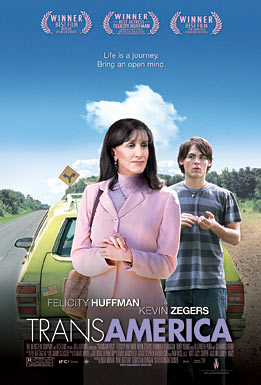
Transamerica (USA, 2005)

Ich möchte heute über den Film "Transamerica" schreiben. Hier geht es um einen Mann, der zur Frau werden will. Er, oder sie, hatte ein Kind, das er seit langem nicht mehr gesehen hatte. Er hat vor einem Jahr eine Geschlechtsveränderungsoperation gebucht. Kurz vor der Operation empfiehlt seine Psychologin, seinen Sohn zu besuchen. Das würde ihm helfen, so die Psychologin, alte Wunden und Probleme zu schliessen, und einfach klar und beruhig zu sein. Er geht zu seinem Sohn, und beide beginnen eine Reise durch die USA bis nach Kalifornien. Diese Reise erweist sich als eine wunderschöne Gelegenheit, seinen Sohn besser kennen zu lernen. Sie kommen endlich nach Kalifornien und dort treffen sie die Eltern des Mannes. Dieser Besuch wird zu einer emotionalen Tragödie, aber am Ende geht es allen gut. Der Mann wird operiert, und als Frau wohnt sie alleine und arbeitet in einem mexikanischen Restaurant. Sie scheint auf jeden Fall glücklicher zu sein, als am Anfang des Films.

10 October 2006

The Scarlett Express (USA, 1934)

Es geht um einen historischen Film von dem Jahr 1934. Hauptdarsteller ist Marlene Dietrich. Sie spielt die Rolle von Katherine II von Russland. Der Film erzählt die Geschichte ihres Weges zum Königreich. Dietrich scheint am Anfang sehr naiv und fromm zu sein. Am Ende wird sie schlau, habgierig und machtlustig. Zuerst wird eine Folterszene gezeigt. Ist es die Zukunft von Marlene in diesem Film? Zeigt es das damalige Leben im Russland? Übrigens ist Katherine profitgierig und bestechlich.

19 September 2006

Today I would like to write about one of my favourite film directors, Ildiko Enyedi, born in Hungary in 1955. Her style is very unique and has always interested me. She has done very few films unfortunately; four in total. I saw her first film a couple of years ago, and this week I had the chance to see two more films from her. I will briefly discuss each one.

I discovered her first film, My 20th Century (Az én XX. Szazadom, Hungary, 1989) by chance while renting a couple of foreign movies. I loved this movie so much I have seen it several times now. It is the story of two twin sisters born in Budapest. Each take a different path in life: one becomes a revolutionary / terrorist and the other one becomes a prostitute in the high-class milieu of Hungarian bourgeoisie. They both meet the mysterious Mr. Z, and at the end their lives will meet again thanks to him. This is what I call a “poetic” film full of images, music, very few dialogue sequences and a very original way of telling the story, very non-linear approach. The black and white photography won this film recognition at the Cannes film festival.

Enyedi’s next movie, the Magic Hunter (Büvös Vadasz, Hungary, 1994) tells the story of a hunter in the Middle Ages, seen thru the eyes of a child. At the same time it is the story of a marriage that is menaced when the wife meets a Russian chess player. The movie moves from past to present effortlessly. Again you can recognise several of Enyedi’s characteristics, like transitions from one scene using strong music scores, floating cameras showing landscapes, and two stories intertwined to create one solid picture.

The last movie I saw is called Tamas and Juli (Tamas és Juli, Hungary, 1997). This is a love story between two young people in a mining town in Hungary. Tamas works at the mines. He falls in love with Julika, a nursery teacher. On New Year’s Eve 2000, Juli decides to go into the mine to spend the night with Tamas, who has to work night shift. The cinematography is really good, and although the movie is only 60 minutes long, it delivers an interesting and sad story.